About Learn Mandarin
Updated September 17, 2026
Learn Mandarin teaches the 3,000 words of HSK bands 1 to 4 to English speakers, using flashcards that schedule themselves. HSK 1 and 2 are free to study, it needs no account, and once you have opened it once it works with no network at all. This page explains what it is, the decisions behind it, and who to write to.
Why 3,000 words
The deck is the HSK 3.0 vocabulary for bands 1 through 4, in the order the standard teaches them. That is a deliberate ceiling rather than a stopping point we have not passed yet. Three thousand words is roughly the span between recognising nothing and reading a menu, a sign, a message from a friend — and it is small enough that finishing it is a real prospect. A deck of thirty thousand words is a reference work. This is meant to be completed.
Within a band, new words do not arrive in dictionary order. They arrive in order of how often they turn up in the deck's own example sentences, so the words holding the sentences together reach you early. Ordered alphabetically, the app opened with 爱, 爱好, 八, 爸爸 — and made you wait until word 377 for 我.
How it works
Every word goes through the same three stages, and the app decides when each one comes.
- Recognise. A card being learned asks you a question before it shows you the answer: what it means, which word went past in the sentence you just heard, which tones it carries, which word fills the gap.
- Review. Reviews are scheduled by FSRS, a modern spaced-repetition algorithm: each time you grade a card, it re-estimates how long until you would forget it and books the next review just before that. Cards you find easy drift weeks apart. Cards you keep losing come back tomorrow.
- Produce. Once a card's interval passes 21 days the questions turn around and ask you to produce the word rather than recognise it: write the character and have the strokes graded, type the pinyin, or put the word back into one of its own sentences, and a noun is also asked which measure word it takes. Recognising 走 among four options is not the same skill as writing it on a form.
What is on a card
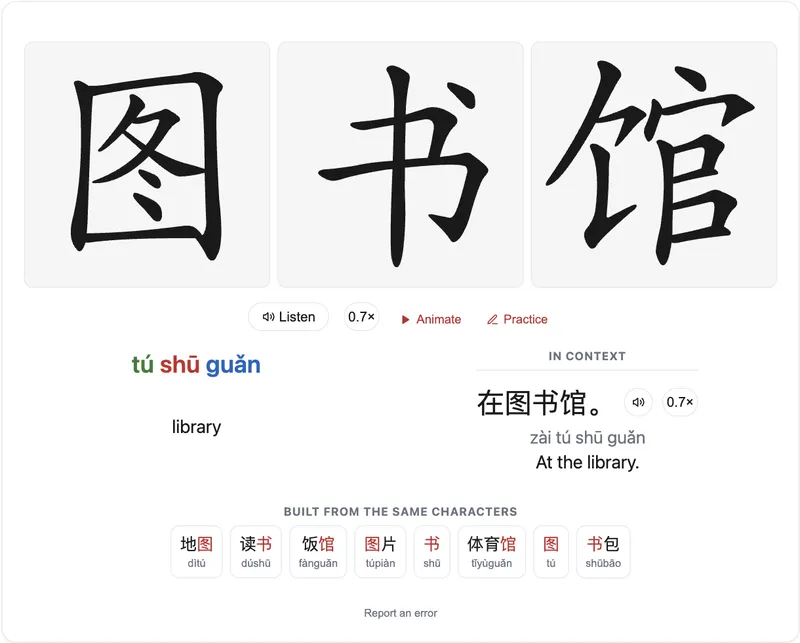
Every one of the 3,000 words carries the simplified characters, pinyin with a colour per tone, stroke-order animation you can also trace yourself, at least one example sentence with a translation, and spoken audio for both the word and its sentence — 6,000 clips, at full speed and at 0.7× beside it. The words are also grouped into 21 topic packs, so you can study food or travel or family rather than working down a list.
Where the material comes from
Almost none of the language data is ours, and that is the point: definitions come from CC-CEDICT, example sentences from Tatoeba's contributors, stroke data from Make Me a Hanzi, and the audio is Google Cloud speech synthesis rather than a recording of a person. Every source, every licence and every modification we make is named on the credits page, because those licences require it and because the people who built those corpora deserve the credit.
Community-maintained data contains mistakes, and this deck has inherited some. Every card has an Error? button beside the character — a report button — a short list of what can be wrong, no free text — and those reports reach us. It is the most useful thing you can send.
Your progress stays on your device
Everything you do is stored in your own browser, not on a server. You do not need an account, and nothing asks you for one. If you want the same progress on a phone and a laptop you can make an account and it will sync between them, and the device stays the source of truth.
Logging out clears this device. It syncs first and only clears once the server has accepted your progress, so signing back in brings everything back — and if the sync cannot get through, nothing here is removed and the app says so rather than throwing away reviews that exist nowhere else. This changed in September 2026: logging out used to leave your cards, goal and streak in the browser, which is the wrong default on a shared or borrowed computer, and that is the case a website cannot detect and so has to assume. Clear this device, in the Account section, does the same thing on demand and is there whether or not you have an account — it is the only way to clear a device you never signed in on.
Deleting the account is different and deliberately narrower: it removes what the server holds and leaves each device's own cards alone. What we hold is explained in full in the privacy policy.
How it is paid for
By a one-time purchase. HSK levels 1 and 2 — 1,244 words, a complete beginner course — are free to study with every feature the app has, and will stay free. Studying HSK 3 and 4, the other 1,756 words, is unlocked by a single payment of US$29 rather than a subscription, because the deck is meant to be finished and a monthly charge for something finished is rent. Every word page on this site stays free to read at every level, and the vocabulary data itself stays under the open licence the credits describe: what the purchase buys is the app's scheduling, checks and progress for those two levels. Pricing sets out what is free and what is not.
We said something different here until September 2026: that money would only ever remove adverts. That plan assumed adverts were running, and they were not — the site was never approved to show them, so paying to remove them would have bought nothing. We changed it before anyone had bought anything. Adverts may still appear on the word pages; there will be none inside a study session, you will be asked before any advertising cookie is set, and anyone who has bought the unlock will not see them at all.
Questions people ask
Is this just a word list?
No. Every word comes with an example sentence and its translation, audio for both, and stroke order you can watch or trace. Within each level, new words arrive in order of how often they turn up in the deck's own sentences, so common words come first. And once a word has stuck, its card stops asking you to recognise it and asks you to produce it: write the character, type the pinyin, or put it back into a sentence.
Is HSK 4 enough for me?
The deck is the 3,000 words of HSK 3.0 bands 1 to 4, which take a learner from a first word to the intermediate level. It is meant to be finished, not to go on for ever, and there are no plans for bands 5 and 6. If you already know most of these words, the placement check at the start will tell you, and this deck is probably not for you.
How is it different from Anki?
The deck is already built, so there is nothing to import, format or set up: audio, stroke order, example sentences and colour-coded tones are part of every card. The scheduling is FSRS, the same algorithm Anki offers as an option, running with no settings to tune. You do not need an account, and your progress stays in your browser unless you choose to sync it. The full comparison sets the two side by side, and there is one with Pleco too.
What is free?
Studying HSK 1 and 2, which is 1,244 words, is free with every feature, and will stay free. Every word page on this site is free to read at every level. Studying HSK 3 and 4 in the app is a single one-time purchase of US$29, not a subscription, and the Terms of Use say what it buys.
Does it work offline?
Yes, once it has loaded once. It installs to your phone or computer from the browser, keeps the whole deck on the device, and fetches the audio and stroke order for a session when the session starts, so a session begun online carries on without a connection.
Do I need an account?
No. Your progress is kept in your browser on the device you study on. An account is optional and exists only to sync that progress between your devices, and you can delete it from inside the app.
Who makes it
Erick K. Watson builds and runs it, and answers the email address at the bottom of this page. He has spent fifteen years in product at Google, Microsoft and Protocol Labs, and works as a fractional product lead — erickwatson.com says what that means, and LinkedIn and X are where to find him.
Learn Mandarin is operated by SproutVest, LLC, a Washington limited liability company, doing business as Learn Mandarin. The software is proprietary and its source is not published. So the privacy policy's central claim is offered as something you can check rather than something you have to take on trust: your progress is held in your own browser's storage, which your browser's developer tools will show you, and you can clear it yourself from the Progress screen. Parts of the app were written with the help of an AI assistant, which is set out on the AI disclosure page.
Getting in touch
Corrections to the deck, questions, licensing, or anything else: [email protected]. A real person reads it.
SproutVest, LLC d.b.a. Learn MandarinUnited States
[email protected]